

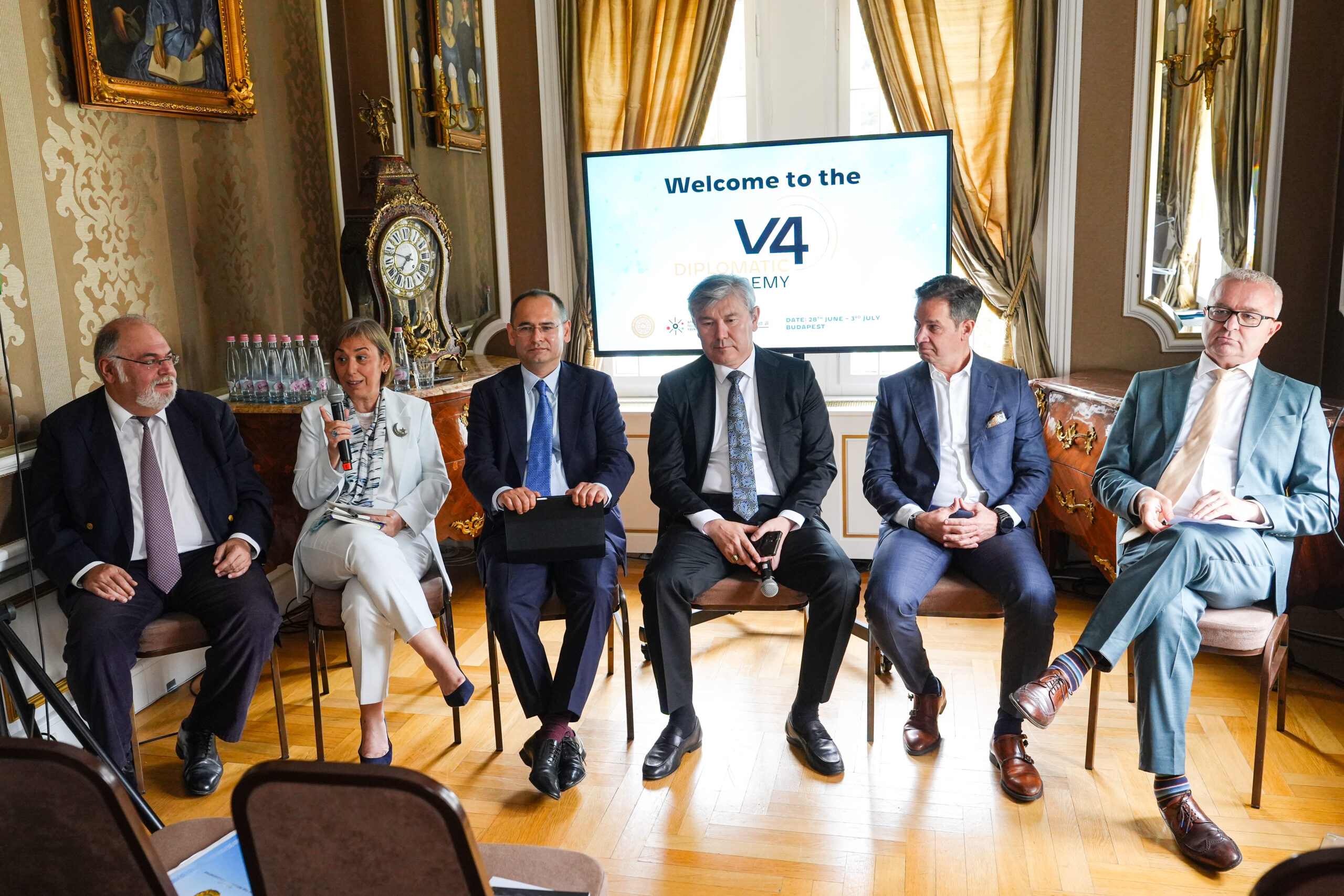
Between 29 June and 2 July 2026, Ludovika University of Public Service, together with its partners, the Wacław Felczak Foundation and the Academy of Polish Careers, hosted the V4 Diplomatic Academy in Budapest. The summer academy focused on diplomacy and public policy, bringing together students from the V4 countries and the Turkic states.
On the 1st of July, a panel discussion was organised within the framework of the V4 Diplomatic Academy in cooperation with the Representative Office of the Organization of Turkic States (OTS) in Hungary. As part of the event, participants of the V4 Diplomatic Academy, together with staff of the Directorate General for International Affairs and the Ludovika Center for Turkic Studies, visited the OTS Representative Office, where they had the opportunity to meet the ambassadors of four OTS member states: Mrs Gülsun Erkul from Türkiye, Mr. Taghir Taghizade from Azerbaijan, Mr. Abzal Saparbekuly from Kazakhstan and Mr Aybek Shakhavdinov from Uzbekistan. They took part in a panel discussion together with Mr. Balázs Hendrich, the Executive Director of the OTS Hungary Office, which was moderated by professor László Vasa, Chief Advisor of the LCTS. The discussion focused on the importance of connectivity, the sovereignty of the Central Asian states, the significance of multilateralism, and Hungary’s role in the OTS as an observer state since 2018.
Ambassador Erkul argued that Türkiye must serve as a cornerstone of strategic security in the region, both for its own security and for that of the wider neighbourhood. Ambassador Taghizade addressed the growing role of the Middle Corridor in Eurasian trade, while also noting that Azerbaijan, even as it seeks to remain one of the EU’s main suppliers of natural gas and oil, is placing strong emphasis on its green transition. Responding to a question from the audience, Ambassador Saparbekuly shared insights from his own diplomatic career, and pointed to balance between East and West as Kazakhstan’s core foreign policy interest, underlining the country’s aspiration to act as a mediator between the two. Ambassador Shakhavdinov highlighted that Uzbekistan, as the most populous country in Central Asia, occupies a position that the region cannot bypass; the historical Silk Road once ran through its territory, such as the Middle Corridor now being built does, making the country an unavoidable factor in regional connectivity despite being doubly landlocked. In his remarks, Executive Director Hendrich noted that Hungary gains considerable benefits from the OTS Representative Office in Budapest, particularly in light of the European Union’s intensifying outreach towards Asia. He added that good relations between Hungary and the whole Turkic world serve the interests not only of Budapest, but also the European Union’s as a whole.
