

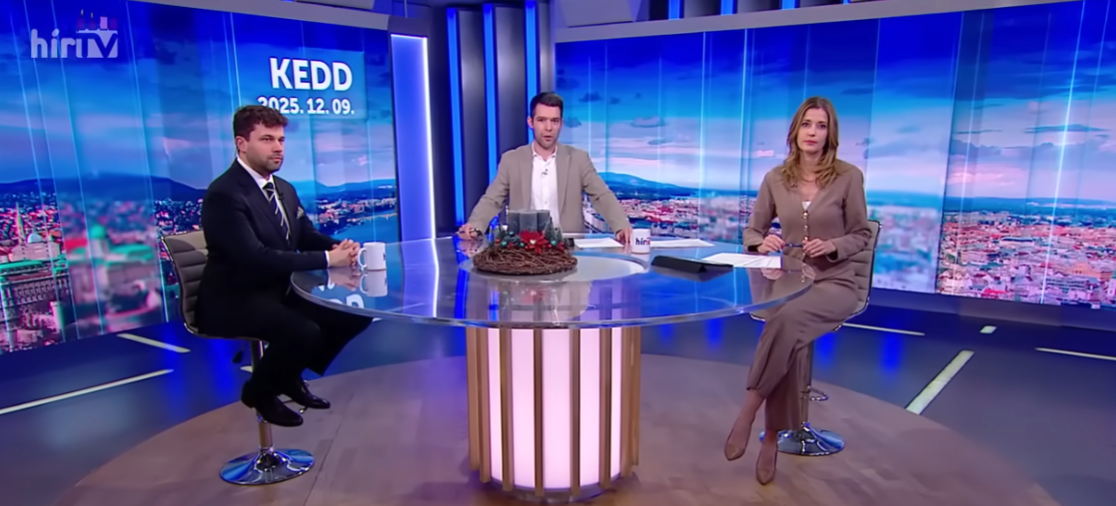
Paweł Pawlowski, Assistant Professor at the University College of Professional Education and researcher at the Ludovika Public Diplomacy Hub, appeared as a guest on HírTV to analyze current developments in Polish domestic and foreign policy. According to his expert assessment, the presidential election held in June did not merely result in a change of leadership, but fundamentally reshaped Poland’s political balance of power.
The election was won by the conservative Karol Nawrocki, creating a new political dynamic vis-à-vis Prime Minister Donald Tusk. Pawlowski argued that Nawrocki is not primarily acting against Tusk, but rather seeks to represent the will of the majority of Polish society. This approach reflects a more sovereigntist political direction, particularly in relation to the European Union’s centralization efforts and its common migration policy. Polish public opinion has grown increasingly skeptical of deeper European integration, while security concerns especially in the shadow of the war in Ukraine have moved to the forefront of political debate.
One of the main arenas of domestic conflict is the judiciary. The current government does not recognize several judges and judicial institutions appointed under the previous leadership, a situation that, according to Pawlowski, has created legal uncertainty and social tensions. These disputes affect not only political institutions, but also ordinary citizens seeking legal redress in the courts.
The future of the Visegrád Group (V4) was also a key topic of the discussion. Revitalizing V4 cooperation is among Nawrocki’s stated objectives, particularly in the fields of security and energy security. Pawlowski believes Poland could assume the role of a regional energy hub, while closer coordination among Central European countries could serve as a counterbalance to excessive EU centralization.
On the issue of migration, Pawlowski highlighted a clear divide between Western Europe and Central and Eastern Europe. Countries in the region aim to learn from Western experiences while preserving their own cultural and social stability. In his view, the European Union should return to its foundational goals economic cooperation and pragmatic policymaking if it is to effectively address the current multidimensional crisis facing Europe.
Photo: Hír TV
Text: Dorottya Balsai
