

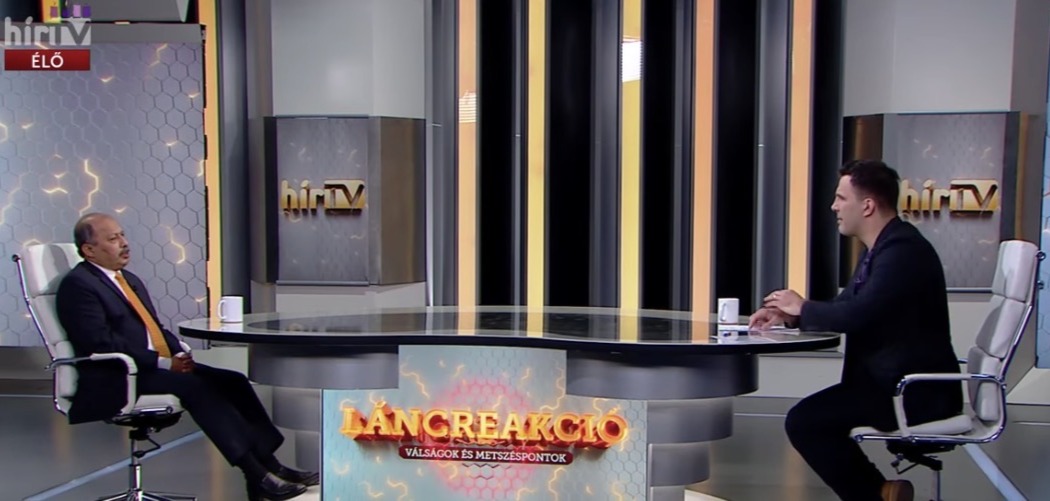
Hungary’s foreign policy approach based on pragmatism and connectivity was highlighted by Mansour Ahmad Khan, former Pakistani ambassador to Kabul and Distinguished Fellow of the Ludovika Public Diplomacy Program, during his appearance on the current affairs program Láncreakció on Hír TV. He argued that interest-based cooperation; rather than ideological positioning; offers a realistic way to strengthen security and manage migration pressures in an increasingly unstable international environment.
From this perspective, Ambassador Khan turned to Afghanistan, where instability continues to generate risks far beyond the region itself. Four years after the Taliban’s return to power, he noted, no inclusive or internationally recognised system of governance has emerged. The absence of political legitimacy and functioning state institutions has left the country locked in a cycle of insecurity and economic decline.
This persistent instability has also created favourable conditions for extremist organisations. Groups such as ISIS, al-Qaeda, and Tehrik-i-Taliban Pakistan (TTP) remain active, posing direct threats to neighbouring states and contributing indirectly to Europe’s wider security challenges. As Ambassador Khan stressed, developments in Afghanistan cannot be treated as a distant regional issue, as their consequences increasingly reach Europe.
One of the most direct consequences of this situation is migration pressure. According to Ambassador Khan, continued insecurity, lack of economic opportunity, and international isolation are likely to push further waves of migration. In the absence of stability at home, migration becomes not a choice but a necessity, reinforcing the link between external crises and internal European security concerns.
The discussion also addressed the withdrawal of U.S. forces from Afghanistan. While the images of the withdrawal damaged Western credibility, Ambassador Khan observed that the transfer of power occurred with relatively limited immediate violence. However, he emphasised that the failure to achieve a negotiated political settlement and the exclusion of broader Afghan society have had lasting consequences, contributing to the current stalemate.
Photo: Hír TV
Text: Dorottya Balsai
