

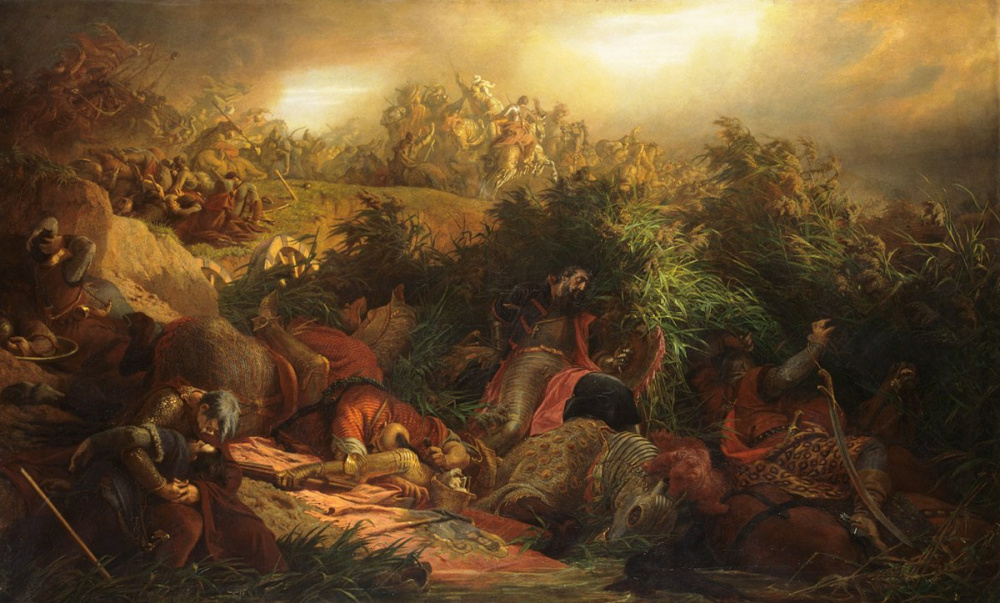
With the Battle of Mohács the medieval Kingdom of Hungary partly collapsed. After that, under the reign of the Habsburgs – unlike, for instance the Czech and Polish states – the Kingdom of Hungary retained its independence, but was unable to act as an independent foreign policy maker until 1918. The 500th anniversary of the disaster at Mohács will be in 2026. The topic plays an important role in Hungarian public discourse, as Mohács is still a symbol of collapse, failure, and hopelessness in everyday language. It is no coincidence that the battle has importance for Hungarian Ottomanists and historians, as during the nearly one and a half centuries that followed, the central territories of the Kingdom of Hungary became part of the Ottoman rule, and Hungarian-Turkish contacts, ranging from military skirmishes to linguistic, cultural, and culinary interactions, became part of everyday life. Also useful to underline, that demographic changes of such magnitude began that the Hungarian population of the Carpathian Basin has still not recovered from them.
From the Turkish perspective, of course, the situation is quite the opposite: Mohács is one of the greatest Ottoman victories, an important success in historical tradition, with which the Ottomans – the superpower of the age – gained a foothold in Central Europe and moved closer to the much-coveted Vienna. Although Turkish historiography placed much less emphasis on preserving the heritage of the Ottoman (and Muslim) state after 1923, Turkishness as a subject of nationalist narrative was given a prominent role in education. In the case of Mohács, the two coincide.
This contradiction is often reflected in public opinion, as many people in Hungary immediately think of a saying or the novel Egri csillagok (Stars of Eger) when they hear the word “Turkish,” rather than the idea that we are “brothers,” as is often heard throughout Türkiye when people learn that someone is Hungarian. It is true that recent Turkish cultural products, especially TV series about the life of Sultan Suleiman, have successfully softened the perception of the Ottoman past in Hungary, but the difference in the images we have of each other does not derives from this. Rather, it is that while in Türkiye, students often encounter the name “Hungarian” in connection with Turkish and Turkic prehistory — as a people who lived alongside or in proximity to the Turkic peoples on the steppes — in Hungarian history teaching, the Turks as a people first appear later, during the 14th-century border wars, and rarely in a positive context. Later, from the 18th century onwards, Western scientific, economic, and political hegemony was so striking that the world’s attention was focused much more on that region than on the achievements of the East.
So while in Hungary – although this may be changing somewhat – the term “Turk” primarily brings to mind Mohács, in Türkiye it is most often associated with Attila and the brotherly, blood ties with the Hungarians. This is why it often happens that a significant part of the Turkish intelligentsia – especially given today’s flourishing bilateral relations – assumes that the Ottoman era is also viewed positively in Hungary.
As we approach the 500th anniversary of Mohács, it may be worth paying attention to how Hungarian-Turkish relations have developed over the past half-millennium, how they have changed, and what external and internal driving forces have been behind the formation of the two nations’ perceptions of each other, both in the past and today. Judging certain chapters of the past retrospectively, based on current politics, can be just as misleading. Just as it is not always appropriate to make predictions about the present or the future based on a certain interpretation of the past. The anniversary of Mohács provides an excellent opportunity to take stock and review the events that took place in relation to it, drawing public attention to aspects that are not always covered in sufficient detail in education.
In this context, the Ludovika Center for Turkic Studies will strive to involve the best experts in order to help the wider public learn as much as possible about the history of Hungarian-Turkish relations from verified sources.
Image source: Székely Bertalan: https://mng.hu/mutargyak/54281/ (Magyar Nemzeti Galéria és Szépművészeti Múzeum)
