

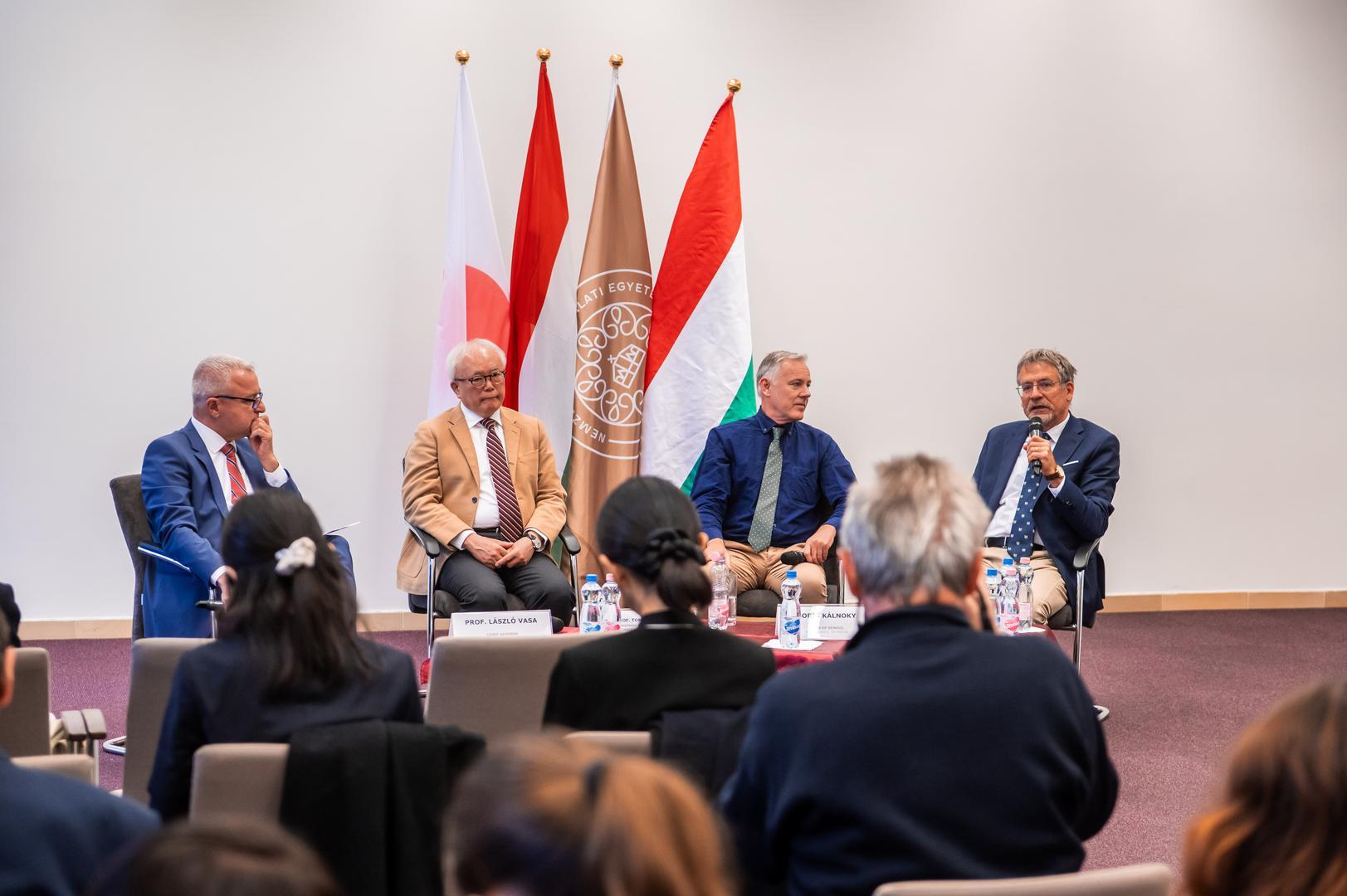
The event titled “The Future Belongs to the Sovereign – Japan and Hungary on Identity and Strategy” was held on 13th November in the Zrínyi Hall of the University, organized by the Directorate General for International Affairs of the Ludovika University of Public Service (LUPS). The guest speaker was Professor Tomohiko Taniguchi, Distinguished Inaugural Fellow of the Ludovika Public Diplomacy Hub.
In her opening speech, Liliána Śmiech, Director General for International Affiars at LUPS, emphasized quoting Japanese writer Haruki Murakami that times put both individuals and nations to the test, and that the future belongs to those who can remain true to themselves. She stressed that Japan exemplifies the harmonious balance between tradition and modernity, while for Hungary, sovereignty is not only a political matter but also a moral and cultural one. As she put it, “the theme of this event—The Future Belongs to the Sovereign – encourages us to reflect on how a country can preserve its identity amid the changes of the modern world.”
In her remarks, she recalled the long-standing history of Hungarian–Japanese friendship, the shared respect for knowledge, discipline, and high-quality work, as well as the importance of preserving national identity in an era of globalization. Liliána Śmiech pointed out that Hungary and Japan face similar challenges: demographic change, the need to strengthen families and communities, and the preservation of traditions in the age of globalization. She underlined that from Hungary’s perspective, uncontrolled migration is not a solution: stability is built on secure borders, clear rules, and the protection of cultural identity. She added that sovereignty in the 21st century is not merely political but also a moral questionan expression of confidence that a nation can defend its values while adapting to change.
Professor Taniguchi’s keynote speech highlighted the importance of protecting national identity, tradition, and sovereignty against the ideas of the modern world. He identified several contemporary trends including anti-nationalism and anti-traditionalism which, in his view, threaten national cohesion and cultural stability. As a counterpoint, he cited Japan, which he said has preserved its traditions and cultural continuity for two millennia, especially through the institution of the Imperial Family. He emphasized that tradition and national identity form the backbone and stability of a nation, in contrast to modern Western ideologies that, in his assessment, excessively relativize culture, gender, and morality. He spoke appreciatively and highly of Hungary for resisting anti-nationalist currents and for defending its cultural unity. According to the professor, genuine independence is found not in isolationism but in fidelity to one’s values and confidence in oneself.
The roundtable discussion that followed involving the Professor Taniguchi, Ferenc Hörcher, Director of the Institute of Political and State Theory at the Eötvös József Research Centre (EJKK) under LUPS, and Boris Kálnoky, Head of the MCC School of Media, moderated by László Vasa, Chief Advisor, Head of the Ludovika Center for Turkic Studies at LUPS addressed the practical challenges of sovereignty in the 21st century: demographic shifts, migration, technological dependence, and the strategic role of artificial intelligence.
Participants discussed Hungary’s situation, emphasizing that from the Hungarian perspective, sovereignty primarily means freedom the right of a nation to decide its own fate. They highlighted that preserving national identity including language, tradition, culture, and historical constitutional foundations is a prerequisite for political freedom, while international cooperation remains indispensable, particularly with partners such as Japan and the United States.
They also noted that Japan’s example shows that modernization and tradition does not need to be opposites; technological advancement is compatible with the preservation of national language and culture. The participants agreed that sovereignty today is also a matter of cultural self-identity and digital self-determination. As they put it, the future belongs to nations that preserve their language, traditions, and moral integrity while remaining open and wise in adapting to a changing world.
Text: Éva Harangozó
Photo: Dénes Szilágyi
